
 listicle
Affordable STEM Kits for Primary Students: 2026 Guide
Table of Contents
- The Benefits of STEM Education for Children
- Affordable STEM Kits for Primary Students: What to Look For
- DIY Science Projects for Primary School Students
- Top Affordable STEM Kits for Primary Students at MasterKids
Last Updated: August 17, 2026
The Benefits of STEM Education for Children
STEM education teaches science, technology, engineering, and mathematics through connected, hands-on activities that build real thinking skills in children. It teaches children how to ask questions, test ideas, and work through problems step by step.
According to UNESCO's education and skills development resources, children who engage with inquiry-based learning from an early age develop stronger critical thinking and problem-solving abilities. The earlier children start exploring the engineering design process and the scientific method, the more natural those habits become.
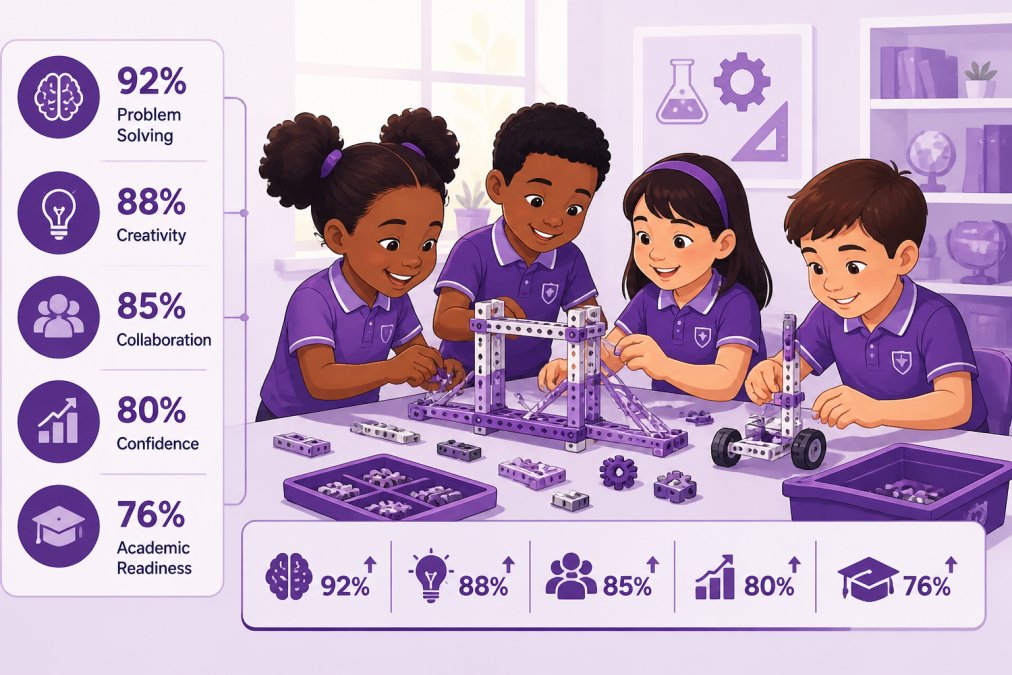
At MasterKids, we see this firsthand. Parents tell us that children who regularly work with stem kits show greater confidence when they face unfamiliar challenges, not just in class but at home too.
The core benefits for primary-age children include:
- Critical thinking and logical reasoning: Children learn to observe, question, and draw conclusions rather than accept answers passively.
- Spatial awareness: Building and engineering activities develop the ability to think in three dimensions, which supports mathematics and reading comprehension.
- Collaborative projects: Many stem activities teach children to share ideas, divide tasks, and respect different approaches.
- Technical literacy: Early exposure to coding fundamentals and simple robotics prepares children for a world where digital skills are expected.
- Creative exploration: Open-ended discovery-based activities encourage children to experiment without fear of being wrong.
Children who participate in project-based learning from primary school tend to stay more engaged with formal education as they progress. Affordable stem kits make this kind of learning accessible at home, not just in school.
Affordable STEM Kits for Primary Students: What to Look For
Choosing the right stem kits requires a few key criteria to separate genuinely useful kits from ones that sit untouched after the first afternoon.
Age-appropriateness comes first. A kit designed for ages 8 and above will frustrate a five-year-old and bore a twelve-year-old. Always check the recommended age range and match it honestly to your child's current ability.
| What to Check | Why It Matters | What to Look For |
|---|---|---|
| Age range on packaging | Prevents frustration or boredom | Match to child's actual ability |
| Materials quality | Affects safety and durability | Non-toxic, sturdy components |
| Curriculum integration | Supports school learning | Ties to science or maths topics |
| Reusability | Better value over time | Components that work across projects |
| Instructions clarity | Reduces adult intervention needed | Step-by-step guides, picture-based |
Safety is non-negotiable. Look for kits with components that meet recognised international toy safety standards. Small parts are a real hazard for children under three. As the Standards Organisation of Nigeria's consumer guidance advises, parents should verify that products carry appropriate safety markings before purchase.
Reusability adds genuine value. The best affordable stem kits allow components to be reconfigured into multiple projects. Look for STEM bins or modular sets rather than kits that produce one fixed outcome.
Curriculum integration matters. The most effective kits connect to what children are already learning at school. When a child builds a simple circuit at home and then encounters electricity in class, the two experiences reinforce each other.
DIY Science Projects for Primary School Students
Meaningful STEM activities do not always require a purchased kit. DIY science projects using household materials are among the most effective tools for building curiosity and the scientific method in young children.

According to the Royal Society of Chemistry's education resources, hands-on experimentation at home significantly reinforces classroom science concepts when children are encouraged to predict outcomes before they begin.
Here are five DIY projects that work well for primary school children:
1. Volcano reaction 🌋 Mix bicarbonate of soda and vinegar in a container. Ask your child to predict what will happen before they pour. Discuss the gas produced and why the reaction occurs.
2. Bridge building challenge 🏗️ Give your child paper, tape, and lolly sticks. Challenge them to build a bridge that holds the most weight. This builds spatial awareness and logical reasoning.
3. Seed germination journal 🌱 Plant seeds in clear plastic cups so the roots are visible. Have your child draw and date what they observe each day. This builds scientific method habits.
4. Simple circuits with a battery kit 💡 A low-cost battery, wire, and a small bulb introduce electrical concepts with immediate, visible results.
5. Paper aeroplane aerodynamics ✈️ Fold different designs and measure how far each flies. Change one variable at a time and record results. This is genuine inquiry-based learning in action.
DIY projects are a practical answer to budget constraints. When families cannot access affordable stem kits immediately, these activities keep children engaged with discovery-based learning at no cost.
Top Affordable STEM Kits for Primary Students at MasterKids
Finding affordable stem kits that are genuinely safe, age-appropriate, and durable in one place is harder than it sounds. MasterKids was built specifically to solve this problem for families. Every product in our range is curated for quality, safety, and educational value.
Our stem kits span the full primary school age range. Whether your child is just beginning to explore educational toys at age four or is ready for more structured robotics and coding fundamentals at age eleven, there is a kit designed for where they are right now.
What makes our range different:
- Verified safety standards: Every kit is selected with safety as the primary filter.
- Skill development by age group: Our kits are organised by developmental stage, so you can match the right level of challenge to your child's current abilities.
- Reusable, modular designs: Many of our kits are designed as STEM bins with components that support multiple projects.
- Curriculum-aligned options: Several kits connect directly to primary school science and mathematics topics, supporting classroom learning at home.
Quick Picks from MasterKids: 🎯
- Best for ages 4-6: Introductory building and colour-sorting kits that develop spatial awareness and early logical reasoning
- Best for ages 7-9: Science experiment sets covering the scientific method, simple chemistry, and basic engineering design
- Best for ages 10-12: Coding and robotics starter kits that introduce technical literacy and collaborative projects
A common mistake parents make is buying a kit that is slightly too advanced, hoping the child will "grow into it." In practice, this leads to frustration and the kit going unused. Start at the right level and progress from there.
As highlighted by UNICEF's learning through play research, children learn most effectively when play is structured around achievable challenges that gradually increase in complexity. That principle is built into every kit we carry.
Shop our full range of affordable stem kits for primary students at MasterKids and find the right fit for your child's age, interests, and learning stage.
Finding the right affordable stem kits for primary students takes more thought than a quick search suggests. The wrong kit sits in a corner; the right one becomes a fixture of the weekend. MasterKids brings together a curated, safety-verified selection of stem kits and educational toys designed to grow with your child. Shop the MasterKids range and give your child the hands-on learning foundation they deserve.
Frequently Asked Questions
Are STEM kits worth the investment for home learning?
Yes. Affordable STEM kits for primary students give children structured, hands-on learning experiences that build critical thinking, logical reasoning, and problem-solving skills. Rather than passive screen time, a good STEM kit encourages a child to experiment, fail, adjust, and try again. These are habits that support school performance and long-term development. When chosen to match your child's age and interest, a quality kit stays engaging for months, making it good value for money.
How do I choose a STEM kit that matches my child's age and skill level?
Start with the age guidance on the packaging, but also think about your child's confidence with building or science tasks. A kit labelled for ages 6-8 may suit a curious 5-year-old or a child who finds reading challenging. Look for kits with clear instructions, reusable parts, and open-ended activities. Kits that grow with the child, allowing more complex builds over time, offer better value. MasterKids groups products by age range to make this easier.
What are some DIY STEM activity ideas for primary students?
Simple DIY science projects for primary school children include building a bridge from straws and tape, growing beans in a clear cup to observe root development, making a basic circuit with a battery and torch bulb, or creating a volcano with bicarbonate of soda and vinegar. These activities cost very little, use everyday materials, and cover core scientific method concepts such as hypothesis, observation, and conclusion. Many MasterKids STEM kits include guided versions of activities like these.
How do STEM kits help with primary school curriculum alignment?
Quality STEM kits for primary students are designed around inquiry-based learning and the engineering design process, both of which map closely to primary science and mathematics curricula. Activities that involve measurement, prediction, and recording results reinforce classroom lessons. Coding fundamentals and basic robotics kits build technical literacy that aligns with digital skills objectives. Choosing curriculum-aligned kits means learning at home directly supports what children are doing at school.
Where can I find durable and safe STEM kits for kids?
Look for retailers who are transparent about product sourcing and quality standards. MasterKids curates a selection of safe, high-quality STEM kits specifically for the Nigerian market, actively working to remove counterfeit and low-quality items. Each product in the range is chosen for durability and age-appropriateness. Visit the MasterKids website to browse current stock, check product details, and shop with confidence that what arrives matches what was advertised.
This article was written using GrandRanker