
 how-to
How to Keep Kids Engaged With STEM: A Parent's Guide
Table of Contents
- Why STEM Engagement Matters for Your Child's Future
- How to Keep Kids Engaged With STEM Through Hands-On Discovery
- Affordable STEM Kits for Primary Students That Actually Hold Attention
- DIY STEM Projects for Kids at Home Using Household Items
Last Updated: August 29, 2026
Why STEM Engagement Matters for Your Child's Future
🧠 STEM, science, technology, engineering, and mathematics, builds curiosity, problem-solving skills, and critical thinking that shape how children approach challenges throughout their lives.
When children engage with STEM early, they develop stronger cognitive abilities and learn to ask questions, test hypotheses, and iterate when something doesn't work. A child who understands the scientific method knows how to approach any unfamiliar problem systematically. STEM engagement builds what researchers call a growth mindset, helping children realise that struggle is discovery, not failure. At MasterKids, the right tools and activities unlock this potential in children of all ages.
How to Keep Kids Engaged With STEM Through Hands-On Discovery
The most effective way to keep kids engaged with STEM is through hands-on activities that let them build, experiment, and see results immediately.
Construction kits are the gateway. Whether simple building blocks for younger children or robotics kits for teenagers, physically assembling something teaches spatial reasoning, problem-solving, and patience. Inquiry-based learning works because it respects how children think, instead of explaining how magnets work, ask what they think will happen if you put metal near a magnet, then let them test and discover.
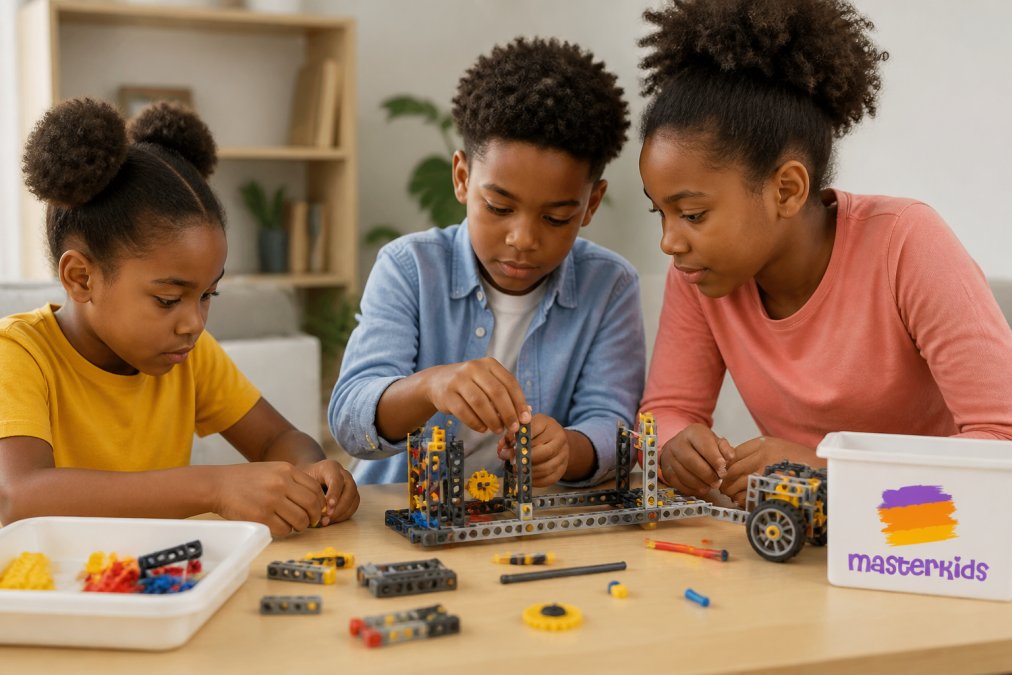
Real-world application keeps engagement high. Show your child where STEM matters in daily life: cooking involves chemistry and measurement, building involves engineering, gardening involves biology and data analysis. Collaboration amplifies engagement, pair children together on projects so they explain their thinking and learn that different approaches work.
Affordable STEM Kits for Primary Students That Actually Hold Attention
The best STEM kits balance challenge with accessibility and novelty with sustainability.
Look for kits that grow with your child and offer something interesting across multiple age ranges. Quality matters more than quantity, a single well-designed kit with durable components that a child returns to repeatedly beats a collection of cheap kits that break or bore within weeks.
Safety and authenticity are non-negotiable. Counterfeit kits cut corners on safety standards. Sourcing from trusted retailers like MasterKids, where every product is vetted for safety and quality, means you're getting genuine items that work as intended and won't pose risks to your child. The best kits for primary students combine hands-on construction with basic scientific principles, building a simple circuit teaches electricity, assembling a model teaches mechanics, growing crystals teaches chemistry. With nationwide delivery available, you can access quality STEM resources regardless of where you live.
DIY STEM Projects for Kids at Home Using Household Items
You don't need expensive kits to foster STEM engagement. Household items work remarkably well for hands-on learning.
Water and containers teach fluid dynamics and measurement. Fill bottles with water, add food colouring, and explore how liquids behave. Paper and tape become engineering challenges, can your child build a structure that holds a specific weight? Kitchen experiments teach chemistry without risk: baking soda and vinegar reactions, salt crystal growing, and mixing colours are genuine chemical processes. Recycled materials spark creativity and sustainability thinking, teaching resourcefulness and showing children that innovation means working with what you have.

The beauty of DIY STEM projects is that they teach the scientific method through natural curiosity. Your child experiments, observes, and learns from what happens.
Keeping children engaged with STEM doesn't require expensive equipment or specialist training. It requires curiosity, permission to experiment, and access to tools that work. When you combine hands-on discovery with quality resources from trusted sources like MasterKids, you create an environment where children naturally develop the critical thinking and problem-solving skills that will serve them throughout their lives. Explore MasterKids's curated STEM kits and resources designed specifically for children at every stage of development, each one chosen for safety, durability, and genuine learning value. 🚀
Frequently Asked Questions
Q: What is the best age to start introducing STEM concepts to children?
A: You can begin early, even toddlers benefit from exploration and sensory play. Structured STEM activities work best from age 5 onwards, when children can follow instructions and engage in problem-solving. However, curiosity and questioning should be encouraged from the moment children start asking 'why?' The key is matching the complexity to their developmental stage. Younger children thrive with hands-on building and experimentation, whilst older primary students can tackle more complex engineering design challenges.
Q: How can I keep my child engaged if they seem to lose interest in STEM activities quickly?
A: Interest drops when activities feel too difficult or too easy. Start by observing what naturally captures their attention, building, cooking, nature exploration, or taking things apart. Build STEM around those interests rather than forcing a kit they don't connect with. Rotate activities frequently, involve them in choosing projects, and celebrate small discoveries. Growth mindset matters too: praise effort and problem-solving attempts rather than results. Sometimes stepping back and letting them lead the activity keeps engagement alive longer than structured lessons.
Q: What are the benefits of STEM education for children beyond school performance?
A: STEM builds critical thinking, logical reasoning, and creativity, skills that apply far beyond exams. Children develop resilience through experimentation and failure, learn to break complex problems into manageable steps, and gain confidence in their ability to figure things out. Hands-on STEM also improves spatial awareness, fine motor skills, and collaborative abilities. Perhaps most importantly, early STEM engagement helps children see themselves as capable problem-solvers and innovators, which influences their academic choices and career pathways well into the future.
This article was written using GrandRanker