 blog
blog
7 Ways to Teach Math Through Play
Table of Contents
- Why Play Is the Best Way to Build Early Numeracy
- 1. Counting and Number Sense Games
- 2. Hands-On Math Activities with Everyday Objects
- 3. Storytelling and Mathematical Talk
- 4. Baking, Cooking, and Measurement Play
- 5. Building, Sorting, and Pattern Recognition
- 6. Affordable STEM Kits for Primary Students
- 7. Moving Beyond Rote Memorisation
- Quick Guide: Match the Activity to the Skill
- Frequently Asked Questions
Last Updated: September 20, 2026
Why Play Is the Best Way to Build Early Numeracy
Play is the most natural way to teach math through play. Counting games, sorting toys, and pretend play build number sense long before formal lessons begin.
At MasterKids, we see this every day. A child who counts bottle caps on the floor learns faster than one who copies numbers from a book.
Research from UNICEF's early childhood development guidance confirms that play-based learning builds foundational skills. It also supports cognitive development and problem-solving.
So why does play work so well? Because children learn by doing. They touch, move, and test ideas. Maths stops being abstract and becomes real.
Below, we explore 7 ways to teach math through play. Each one uses simple items you already have at home.
1. Counting and Number Sense Games
Counting games build the base for all later maths. Start with rote counting, then move to matching numbers to real objects.
Try these simple games:
- Count steps as you climb the stairs
- Count spoons while setting the table
- Play "how many" with toys in a basket
- Sing number songs with hand actions
The goal is number sense, not speed. A child who knows that "five" means five things understands more than one who just recites numbers.
2. Hands-On Math Activities with Everyday Objects
Hands-on activities work best when children use real objects. You do not need to buy anything special. Everyday items are enough.
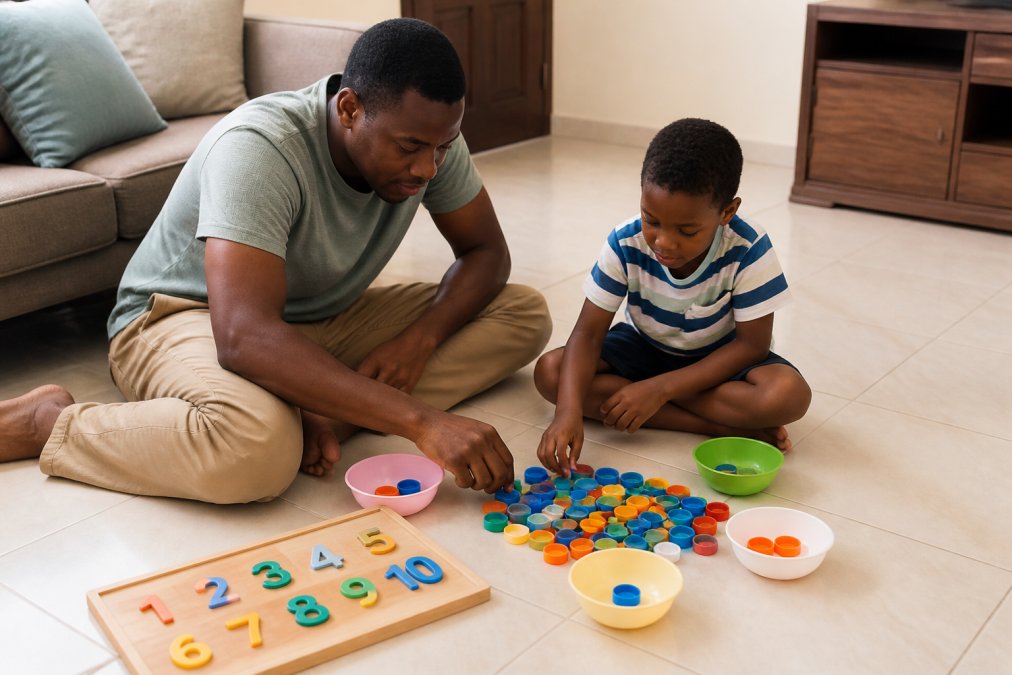
Try these:
- Sort beans, buttons, or bottle caps by colour and size
- Stack cups to compare height
- Match socks into pairs to teach one-to-one matching
- Line up stones to show more and less
These hands-on math activities build spatial awareness and pattern recognition. They also keep children engaged for longer than worksheets.
3. Storytelling and Mathematical Talk
Stories carry maths without children noticing. When you read together, point out numbers, shapes, and sizes.
Mathematical talk means saying your thinking out loud. For example:
- "You have three biscuits. I have two. Who has more?"
- "This cup is full. That one is empty."
- "Let's find the biggest leaf."
This kind of talk builds mathematical reasoning and critical thinking. It also grows vocabulary.
4. Baking, Cooking, and Measurement Play
Cooking is maths you can eat. Measuring, pouring, and counting turn into a fun lesson.
Let children help with:
- Counting cups of flour
- Measuring spoons of oil
- Comparing small and large bowls
- Setting a timer and watching it count down
Measurement and geometry appear naturally here. So does patience.
The NHS advice on cooking with children notes that kitchen tasks build confidence and motor skills too.
5. Building, Sorting, and Pattern Recognition
Building toys teach shape, space, and pattern. Blocks, bricks, and stacking rings all work well.
Sorting and pattern games include:
- Making a red-blue-red-blue pattern with beads
- Grouping toys by shape or size
- Building towers and counting the blocks
- Copying a simple pattern you start
Pattern recognition is a key early numeracy skill. It leads straight into algebra later on.
A common mistake is rushing to "correct" answers. Let children test their own patterns first.
6. Affordable STEM Kits for Primary Students
Affordable STEM kits for primary students bring structure to play. They combine building, counting, and problem-solving in one box.
Good kits should:
- Match your child's age
- Use safe, non-toxic materials
- Include clear picture guides
- Offer more than one way to play
This is where MasterKids helps. We stock safe, high-quality STEM kits and educational toys for every stage, from newborns to teens, and we offer nationwide delivery so families across the country can get them. Every item is checked so you avoid counterfeit and low-quality products.
7. Moving Beyond Rote Memorisation
Rote memorisation alone does not build maths literacy. Children need to understand why numbers work.
Move beyond memorisation by:
- Asking "how do you know?"
- Letting children explain their thinking
- Using objects to show answers
- Linking maths to daily routines
Assessment through observation matters here. Watch how your child solves a problem, not just the final answer. This tells you what they truly understand.
For children who find maths stressful, keep sessions short and playful. Maths anxiety prevention starts early. Praise effort, not speed.
Digital apps can help, but balance them with analog play. Hands-on time still wins for young learners.
Quick Guide: Match the Activity to the Skill
| Activity | Skill Built | Best Age |
|---|---|---|
| Counting games | Number sense | 2-5 years |
| Sorting objects | Pattern recognition | 3-6 years |
| Cooking and baking | Measurement | 4-8 years |
| Building blocks | Spatial awareness | 3-7 years |
| STEM kits | Problem-solving | 6-11 years |
Frequently Asked Questions
How can play be used to teach math?
Play lets children touch, move, and count real objects, which builds number sense far better than worksheets alone. Simple activities like sorting bottle caps, counting steps, or sharing snacks teach addition and subtraction without pressure. When a child rolls a dice, counts spaces, and moves a counter, they are practising rote counting and problem-solving at the same time. The key is to keep it fun and let the child lead.
What are the best educational toys for teaching math concepts?
Building blocks, counting beads, shape sorters, and simple board games work well for younger children. For primary students, affordable STEM kits for primary students that include measuring tools, pattern cards, or basic coding games make maths tangible. Look for toys that match your child's stage and let them explore at their own pace. MasterKids stocks a range of safe, high-quality options for every age.
How can I use everyday household items to teach math?
You do not need special equipment. Use spoons for counting, cups for measuring, and socks for pairing and sorting. During cooking, let your child measure rice or count tomatoes. When setting the table, ask them to work out how many plates are needed. These hands-on math activities build mathematical reasoning and spatial awareness using items you already own.
Why is play-based learning effective for STEM education?
Play-based learning encourages children to ask questions, test ideas, and solve problems, which are the same skills used in science, technology, engineering, and maths. When a child builds a tower and watches it fall, they are learning about balance and measurement. This approach builds foundational skills and critical thinking without the fear that can come with formal lessons. It also keeps student engagement high.
Maths does not have to feel like a chore. The challenge is finding safe, quality learning tools your child will actually enjoy.
MasterKids makes that easier. We offer curated picks for every stage of childhood, a focus on STEM and educational development, and a safe, high-quality product selection. We also provide nationwide delivery, so learning resources reach you wherever you are.
Get started with MasterKids and give your child the joy of learning through play.