
 blog
blog
Fisher-Price Remote Control Toys: A Parent's Guide
Table of Contents
- Why a Fisher-Price Remote Control Toy Is More Than Just a Gadget
- The Developmental Benefits of Remote Control Toys for Toddlers
- Choosing the Right Fisher-Price Remote for Your Child's Age
- Safety and Durability: What Parents Need to Know
- Best Problem Solving Toys for Preschoolers: Beyond the Remote
- How to Operate and Maintain Your Child's Remote Control Toy
- Frequently Asked Questions
Last Updated: September 27, 2026
Why a Fisher-Price Remote Control Toy Is More Than Just a Gadget
A Fisher-Price remote control toy is a child-sized plaything that mimics a real remote, often paired with a vehicle or musical features, designed to build early skills through button-pressing and pretend play. It looks simple on the shelf. In practice, it is one of the most effective first "cause and effect" tools you can hand a toddler.
At MasterKids, we see parents walk past these toys every day, assuming they are just noise-makers. That is a mistake. The best ones combine tactile feedback, sound, and movement into a single activity that holds a young child's attention far longer than a plain rattle.
Here is the honest part most guides skip: a remote control toy only earns its place in your home if it matches your child's stage. Buy too advanced, and it gathers dust. Buy too simple, and it is abandoned within a week.
Below, we break down the developmental benefits, how to pick the right one by age, and what to check before you buy.
The Developmental Benefits of Remote Control Toys for Toddlers
The developmental benefits of remote control toys for toddlers come down to one idea: they let a child make something happen. That single loop, press a button and watch a car move or hear a song, teaches more than most parents expect.
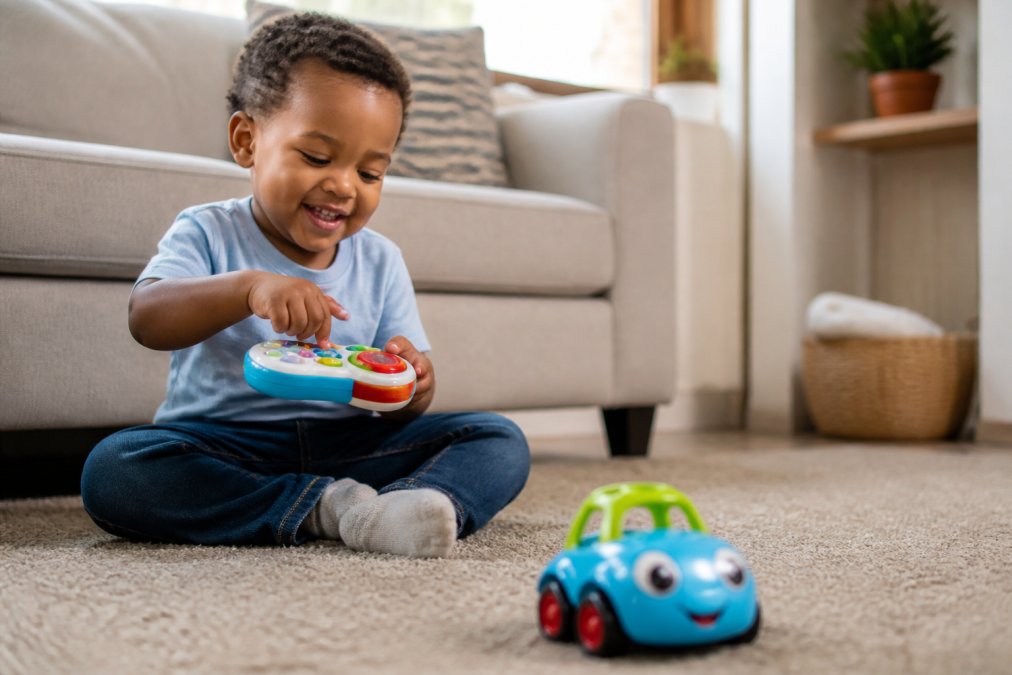
Building Fine Motor Skills and Hand-Eye Coordination
Fine motor skills are the small, precise movements of the hands and fingers. A toy remote with easy-to-press buttons gives a toddler daily practice at exactly that.
Each press requires the child to aim, push, and release. Repeat that dozens of times and you are quietly training hand-eye coordination. Look for chunky buttons and an ergonomic design that fits small hands without forcing an awkward grip.
Encouraging Imaginative Play and Cognitive Growth
Cognitive growth in early childhood often comes through pretend play. A toy remote lets a child copy what they see adults do, which is how imaginative play begins.
Many models add musical feedback or character phrases. That combination of sound and action supports auditory stimulation and keeps the play loop going. Over time, children start inventing their own games, driving a pretend car to a pretend shop, and that is where real learning happens.
Choosing the Right Fisher-Price Remote for Your Child's Age
Age is the single biggest factor in whether a remote control toy gets played with or ignored. A toy that is age-graded correctly will be picked up again and again. But age alone is not enough. You also need to match the toy to your child's current developmental milestones and understand the difference between a simulated learning remote and a functional RC vehicle.
Simulated Learning Remote vs. Functional RC Vehicle
Most parents do not realise there are two distinct categories, and buying the wrong one leads to frustration.
A simulated learning remote looks like a real remote but does not control a vehicle. It responds with lights, songs, and phrases when buttons are pressed. It is designed for cause-and-effect discovery and pretend play. These are ideal for children who are still learning that their actions make something happen.
A functional RC vehicle comes with a remote that actually drives a car or truck forward, backward, and sometimes left or right. It requires directional understanding and more precise hand control. These suit children who have already mastered the press-and-react loop and are ready for a bigger challenge.
If you buy a functional RC vehicle for a child who is not ready, they will press buttons randomly and lose interest. If you buy a simulated remote for a child who is ready for real control, they will quickly find it boring. Use the table below to match the toy to your child's stage.
| Child's Stage | Developmental Focus | Best Toy Type | Key Feature to Look For |
|---|---|---|---|
| 12-18 months | Cause and effect, fine motor practice | Simulated learning remote | Chunky buttons, simple sounds, no complex controls |
| 18-36 months | Pretend play, language development | Musical simulated remote | Volume control, character phrases, light-up keys |
| 3-5 years | Directional control, problem-solving | Functional RC vehicle | Forward/reverse, left/right, durable build |
Aligning with Developmental Milestones
Fine motor milestones matter here. By around 12 months, many toddlers can press a large button with their whole hand. By 18 months, they often use a single finger to poke. By age three, they can usually operate a directional joystick or arrow buttons. Choose a remote that matches these abilities so your child feels capable, not frustrated.
Cognitive milestones also play a role. Between 18 and 36 months, children begin to understand that a button press can cause something to happen elsewhere, a car moving, a song playing. This is the foundation of problem-solving. A simulated remote with clear cause-and-effect feedback supports this stage perfectly.
For preschoolers, the milestone shifts to planning and adjusting.
Safety and Durability: What Parents Need to Know
Safety and durability matter more than any feature list. A toy that breaks easily can expose small parts, and that is a genuine risk for young children. But beyond the basics, parents today want to know what the toy is made of and how to power it safely. This section covers both.
Material Transparency: What to Look For
Not all plastics are equal. For toys intended for toddlers who put everything in their mouths, look for BPA-free and phthalate-free plastics. These are widely considered safer for children. Many reputable brands now state this clearly on the packaging or product page. If a toy does not mention its material safety, treat that as a warning sign.
Battery Safety and Longevity
Battery compartments must be secure. For young children, the compartment should require a screwdriver to open. This prevents access to small button batteries, which are a serious hazard if swallowed. Check that the compartment door fits tightly and does not pop open when dropped.
Durability and Drop Testing
Toddlers drop things. A durable toy survives this. Look for smooth edges, no sharp corners, and a solid feel. Avoid toys that rattle loosely or have parts that seem ready to snap off. An automatic shut-off feature not only saves battery life but also reduces the chance of the toy being left on and overheating.
A common mistake is buying a cheap lookalike to save money. These toys often fail basic safety checks and can break within weeks, leaving sharp edges or loose parts. The saving is never worth the risk.
Check for BPA-free plastics, a screw-secured battery compartment, and a recognised safety mark. For high-drain RC vehicles, use rechargeable batteries. These steps keep your child safe and your toy working longer.
Best Problem Solving Toys for Preschoolers: Beyond the Remote
The best problem solving toys for preschoolers are the ones that make a child think, trial, and adjust. A remote control toy fits this category better than most parents realise.
Rotate toys every couple of weeks. A remote control toy that disappears for a fortnight feels brand new when it returns, and children explore it more deeply the second time.
How to Operate and Maintain Your Child's Remote Control Toy
Operating these toys is straightforward, but a little care keeps them working far longer.
- Insert batteries correctly, matching the polarity marks in the battery compartment.
- Test the buttons with your child before handing it over, so you can show them what each one does.
- Set the volume control to a comfortable level, and use automatic shut-off to save power.
- Wipe the surface with a dry cloth. Never submerge it in water.
- Remove batteries if the toy will sit unused for a long stretch.
Frequently Asked Questions
What are the benefits of remote control toys for toddler development?
Remote control toys support several areas of a toddler's growth. They help develop fine motor skills as children press buttons and turn knobs. Hand-eye coordination improves as they watch the toy respond to their commands. These toys also spark imaginative play and teach cause and effect, which are key parts of cognitive growth. At MasterKids, we stock options that combine these developmental benefits with safe, durable designs.
How do I choose the right Fisher-Price remote toy for my child's age?
Start by checking the age grading on the packaging. For infants, look for simple, chunky remotes with light-up keypads and musical feedback. Toddlers often enjoy functional RC vehicles with easy-to-press buttons and directional control. Preschoolers may prefer more realistic styling and interactive learning features. If you are unsure, our team at MasterKids can help you match a toy to your child's stage.
Are Fisher-Price remote control toys safe for infants?
Fisher-Price toys are generally designed with safety in mind, but you should always check for age recommendations and safety marks. For infants, choose toys with no small parts that could detach. Look for durable construction and non-toxic materials. At MasterKids, we prioritise safe, high-quality products to give you peace of mind.
How do I clean and maintain electronic toys for longevity?
To keep electronic toys working well, wipe them with a damp cloth and mild soap, then dry thoroughly. Avoid soaking them in water. Check the battery compartment regularly for corrosion and remove batteries if the toy will not be used for a while. Store toys in a dry place. Following these steps helps preserve the toy for younger siblings and keeps play safe.
Finding a toy that is safe, durable, and genuinely developmental takes effort, especially with so many low-quality items in the market. MasterKids exists to solve that: a curated range of safe, high-quality toys and STEM kits for every stage of childhood, backed by nationwide delivery. Browse our collection and shop with confidence, knowing every product is chosen to help your child learn through play.