
 blog
blog
Best Problem Solving Toys for Preschoolers in 2026
Table of Contents
- Why Problem Solving Toys Matter for Preschool Brain Development
- Top Problem Solving Toys for Preschoolers: Puzzles, Blocks and STEM Kits
- Choosing Educational STEM Kits for Kids by Age and Stage
- How to Encourage Critical Thinking in Toddlers Through Play
- Problem Solving Toys for Every Child, Including Neurodiverse Learners
- Budget-Friendly DIY Alternatives and Smart Storage
- How to Choose the Right Toy for Your Child's Age
- Frequently Asked Questions
Last Updated: September 16, 2026
Why Problem Solving Toys Matter for Preschool Brain Development
Problem solving toys ask a preschooler to work something out, not just watch it happen. At MasterKids, we see it daily: the puzzle piece that needs turning, the tower that keeps toppling.
Between ages three and five, a child's brain builds pathways for critical thinking, spatial reasoning and executive function fast. Toys that invite trial and error give those pathways something to grip, so working out why the triangle will not fit the square hole practises cause and effect, sequencing and patience in one sitting.
Top Problem Solving Toys for Preschoolers: Puzzles, Blocks and STEM Kits
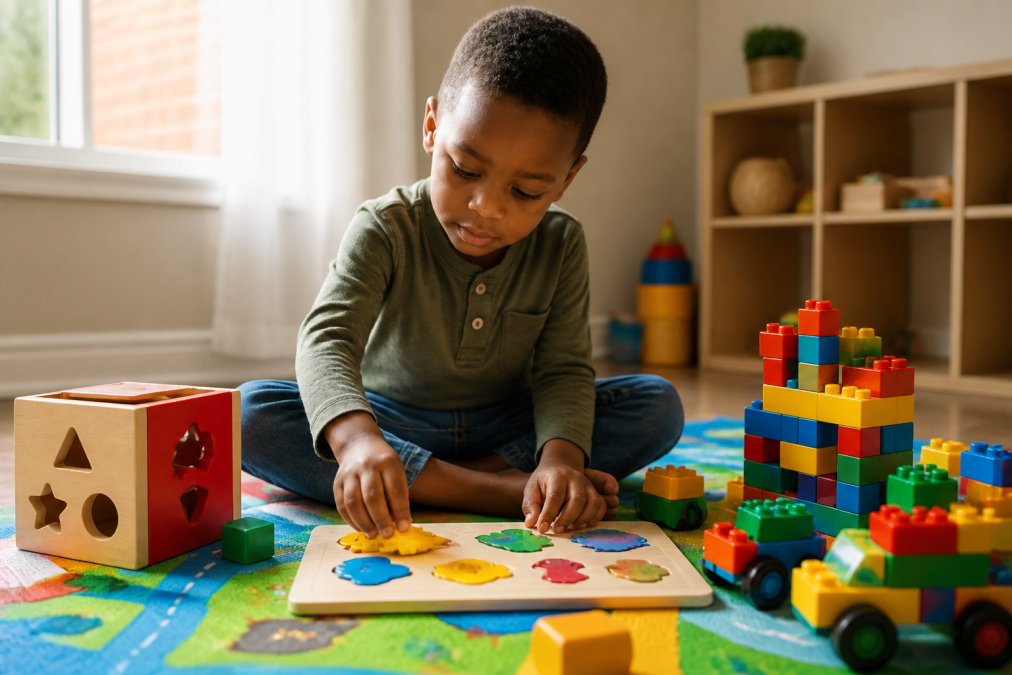
The best problem solving toys for preschoolers fall into a few clear groups, each training a different skill.
1. Puzzles and matching games. These build shape recognition, pattern matching and hand-eye coordination. Start with chunky wooden puzzles, then move to jigsaws with more pieces.
2. Shape sorters and stacking toys. Sturdy and brilliant for fine motor skills, teaching geometric shapes and size order through sensory play and repetition.
3. Construction and building sets. Blocks, bricks and connectors teach engineering concepts, balance and spatial reasoning. Towers fall; your child works out why and tries again.
| Toy type | Main skill built | Best age | What to look for |
|---|---|---|---|
| Puzzles and matching games | Shape recognition, pattern matching | 3-4 | Chunky pieces, clear pictures |
| Shape sorters and stacking toys | Fine motor skills, size order | 2-3 | Smooth edges, sturdy base |
| Construction and building sets | Spatial reasoning, engineering concepts | 3-5 | Easy-grip bricks, open-ended play |
| STEM and coding toys | Sequencing, logical thinking | 4-5 | Screen-free, simple steps |
| Engineering kits | Analytical skills, planning | 4-5 | Few parts, clear instructions |
Choosing Educational STEM Kits for Kids by Age and Stage
Educational STEM kits for kids work best when they match the stage, not the age on the box. A four-year-old given a kit built for sixes will lose interest in a week.
How to Encourage Critical Thinking in Toddlers Through Play
Learning how to encourage critical thinking in toddlers comes down to what you say while they play. Ask "what happens if we try this?" instead of showing the answer.
A few habits that work:
- Let them fail safely. Trial and error is the lesson.
- Ask open questions: "Why do you think it fell?"
- Offer independent play time before you step in.
- Name what they did: "You turned it round until it fit."
Problem Solving Toys for Every Child, Including Neurodiverse Learners
Not every preschooler plays the same way. For neurodiversity-inclusive play, look for toys with clear visual steps, low noise and no pressure to finish.
Budget-Friendly DIY Alternatives and Smart Storage
You do not need to spend a lot. Budget-friendly DIY alternatives work well: cardboard boxes become ramps, bottle tops become counters, pebbles become pattern pieces.
How to Choose the Right Toy for Your Child's Age
Choosing well comes down to four checks:
- Stage, not age. Watch what your child can already do.
- Safety first. Look for smooth edges, non-toxic finishes and no loose small parts.
- Open-ended beats one-answer. More ways to play means more thinking.
- Durability. Sturdy wood and thick plastic outlast thin copies.
MasterKids stocks a curated range for every stage, from first shape sorters to beginner STEM kits, with nationwide delivery across Nigeria. Every item is chosen to be safe, high quality and built to last.
Frequently Asked Questions
What are some good problem solving toys for 4-year-olds?
Four-year-olds do well with jigsaw puzzles of 12 to 24 pieces, wooden building blocks, and simple matching games. Construction sets that need a child to follow a picture and fix pieces in order build spatial reasoning and logical thinking. Shape sorters, threading beads and basic STEM kits also work well because they reward trial and error. Choose open-ended toys so your child can keep finding new ways to play as their skills grow.
How do I choose the right problem solving toy for my child's age?
Match the toy to your child's developmental milestones rather than their birthday alone. Two-year-olds manage chunky shape sorters and stacking cups. Three-year-olds enjoy simple puzzles and large building blocks. Four and five-year-olds can handle pattern matching, sequencing games and beginner STEM kits. Look for safe materials, rounded edges and clear instructions, and check that the toy still leaves room for open-ended play so it grows with your child.
How can parents encourage critical thinking through play?
Ask questions instead of giving answers. When your child is stuck, try 'What do you think will happen if you turn it that way?' Let them fail and try again, because trial and error is how young children build analytical skills. Play alongside them, describe what you notice, and resist the urge to finish the puzzle for them. Short, focused sessions of collaborative play each day build problem-solving skills faster than long, unstructured play alone.
Preschoolers learn to think by doing, failing and trying again. Give them the right toy and the right questions, and the thinking follows. Browse the MasterKids range of puzzles, building sets and educational STEM kits for kids, all picked for safety and real developmental value, and get them delivered anywhere in Nigeria. Shop today and give your child a head start through play.