 listicle
Buy Educational Toys for Kids: 2026 Guide
Table of Contents
- Why Educational Toys Matter for Child Development
- How to Choose Educational Toys by Age
- Best STEM Toys for Kids: Top Picks by Category
- Montessori-Inspired Educational Toys Worth Buying
- Comparing Educational Toy Categories at a Glance
- Safety, Durability, and What to Watch Out For
- Budget-Friendly and DIY Educational Toy Alternatives
- Conclusion
Last Updated: August 16, 2026
Why Educational Toys Matter for Child Development
Educational toys stimulate cognitive, physical, and social-emotional growth through active engagement. According to UNICEF's early childhood development research, the first eight years of life represent the most critical window for brain development, with neural connections forming at a pace never repeated in adulthood.
At MasterKids, we curate toys that build skills, not just habits. Below, we show you how to match toys to developmental stages, which STEM categories deliver the most value, and how to avoid counterfeit, low-quality products.
Cognitive and Social-Emotional Growth Through Play
Play IS learning. Hands-on learning through physical objects builds spatial awareness, logical reasoning, and problem-solving in ways worksheets rarely achieve. When a child stacks blocks and they fall, they're running a physics experiment. When they negotiate rules with a sibling, they're developing social-emotional intelligence.
Research from Harvard University's Center on the Developing Child confirms that play-based experiences build foundational skills children need for academic success, including attention, memory, and flexible thinking.
Screen-Free vs. Digital Learning Tools
Screen-free toys consistently outperform digital alternatives for children under five when it comes to fine motor skills, tactile development, and language acquisition. The physical act of manipulating objects builds hand-eye coordination and sensory processing that a touchscreen cannot replicate.
Digital learning tools have a legitimate role from around age six onwards, particularly for coding and robotics kits. The best approach combines both: screen-free play as the foundation, with purposeful digital tools introduced gradually as children develop the focus and dexterity to use them meaningfully.
How to Choose Educational Toys by Age
Choosing the right educational toy depends on developmental milestones, not the age printed on the box. A child who is slightly ahead or behind the typical curve needs a toy that matches where they are, not where the calendar says they should be.
| Age Group | Developmental Focus | Recommended Toy Types | What to Avoid |
|---|---|---|---|
| 0-12 months | Sensory and tactile stimulation | Soft rattles, high-contrast cards, teethers | Small parts, sharp edges |
| 1-3 years | Fine motor skills, language | Shape sorters, stacking rings, picture books | Complex assembly, screens |
| 3-5 years | Imaginative play, foundational skills | Role-play sets, simple puzzles, art supplies | Overly structured kits |
| 6-12 years | Logical reasoning, curriculum-aligned play | STEM kits, board games, science sets | Passive entertainment |
| 13+ years | Advanced skill-building, independence | Robotics kits, coding tools, strategy games | Age-inappropriate simplicity |
Newborns to 12 Months: Sensory and Tactile Play
Sensory play is the primary learning mode for newborns. High-contrast black-and-white cards support visual tracking. Soft rattles with varying textures build tactile awareness and grip strength. Teething rings that vary in firmness help with oral motor development. The key is variety of sensation, not complexity of function.
Toddlers (1-3 Years): Fine Motor Skills and Language
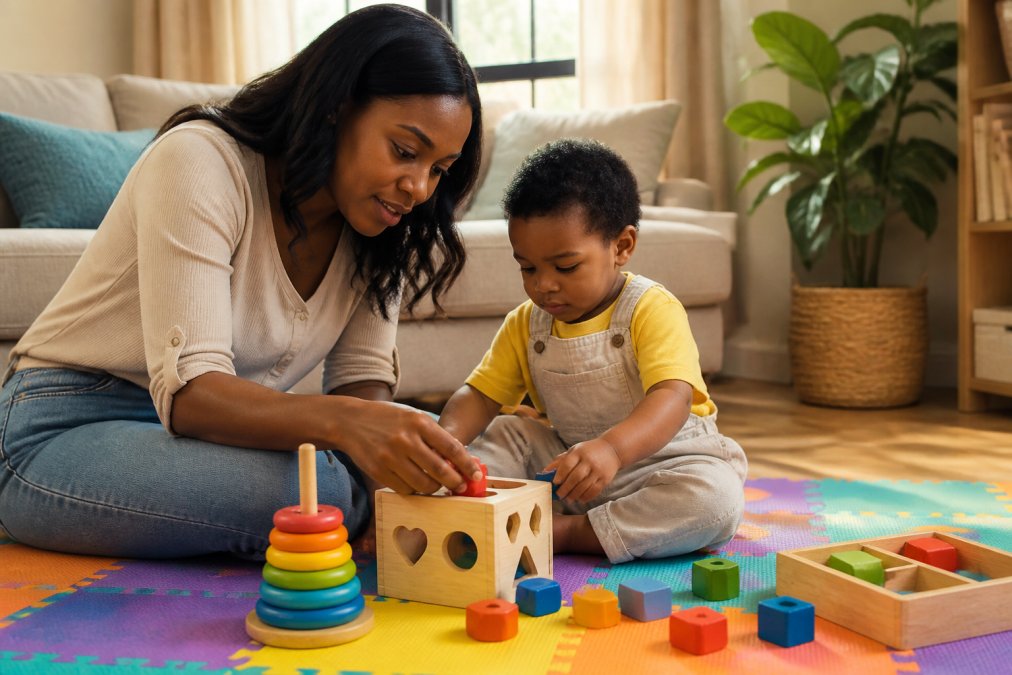
Shape sorters, stacking rings, and simple wooden puzzles build hand-eye coordination and the pincer grip that children will later use for writing. Picture books with single words per page accelerate vocabulary acquisition. Montessori-inspired toys shine at this stage because they emphasise child-led exploration with self-correcting materials.
Preschool (3-5 Years): Imaginative and Foundational Skills
Imaginative play is how preschool children process the world, develop narrative thinking, and understand cause and effect. Role-play sets give children a safe space to rehearse adult roles and develop collaborative play skills.
Foundational literacy tools matter enormously here. Alphabet puzzles, phonics games, and simple rhyming books build early reading skills that predict long-term academic success. Spatial awareness games like tangrams introduce geometric thinking years before it appears in the school curriculum.
Primary School (6-12 Years): Logical Reasoning and Curriculum-Aligned Play
Primary school children are ready for curriculum-aligned toys that reinforce what they are learning in class. STEM kits that involve measuring, building, or experimenting bridge the gap between school lessons and real-world application. Board games that require strategic thinking build logical reasoning and patience simultaneously.
Teens (13+): Advanced Skill-Building and Robotics
Teenagers need challenge, not just entertainment. Advanced robotics kits, programmable microcontrollers, and strategy-based games provide the cognitive complexity that keeps older children engaged. Coding kits that produce a working output give teenagers a sense of real-world competence that builds confidence alongside technical skill.
Best STEM Toys for Kids: Top Picks by Category
The best STEM toys for kids combine a clear learning objective with genuine play value. A kit that sits unopened after the first session has failed, regardless of its educational credentials.
1. Building and Engineering Sets
Building sets develop spatial awareness, structural thinking, and creative problem-solving simultaneously. Open-ended sets, those without a prescribed end result, deliver more developmental value than single-build kits because children return to them repeatedly with new ideas.
Look for sets that are age-appropriate in connector complexity. Very young children need large, snap-together pieces. Primary school children can handle interlocking magnetic tiles or basic mechanical connectors. Teens benefit from sets that introduce actual engineering principles, such as load distribution or gear ratios.
2. Science Experiment Kits
Science experiment kits make abstract concepts tangible. A child who grows crystals, tests pH levels, or builds a simple volcano understands chemistry in a way that a textbook definition cannot achieve. The best kits include enough materials for multiple experiments and provide clear explanations of the science behind each activity.
Safety matters significantly here. All experiment kits should use non-toxic materials and include clear safety guidance. In Nigeria, parents should verify that imported kits meet the Standards Organisation of Nigeria product safety requirements before purchasing.
3. Coding and Robotics Kits
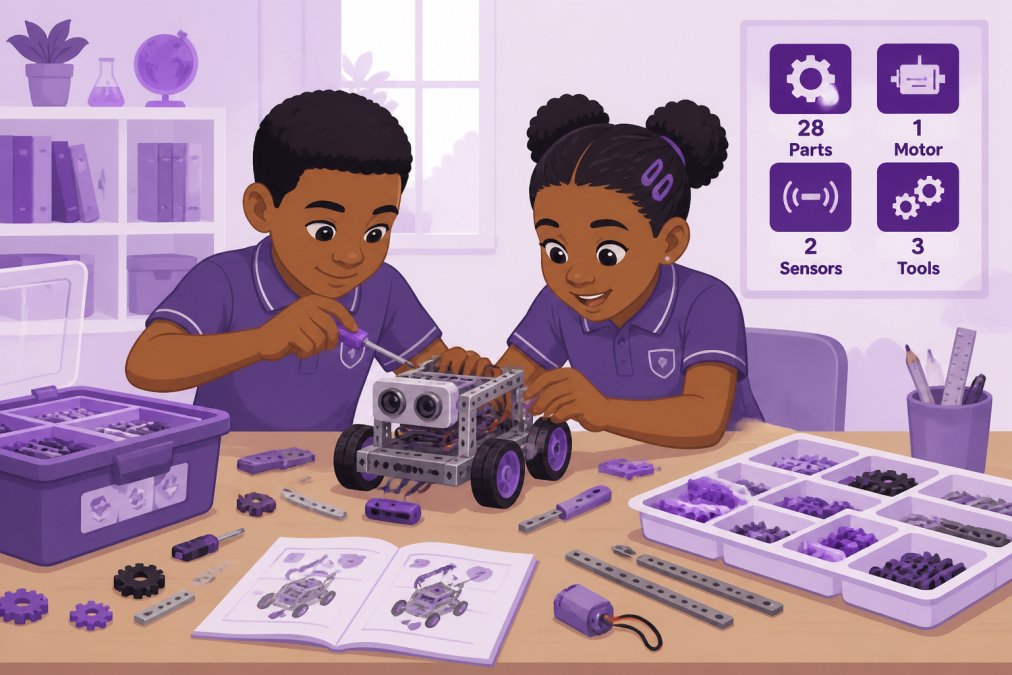
Coding and robotics kits teach skills with direct real-world application. Entry-level kits use block-based visual programming, appropriate from around age seven. More advanced kits introduce text-based coding languages from around age ten onwards.
The most effective kits produce a physical output. A robot that moves, a light that blinks, or a device that responds to input gives children immediate feedback on whether their code worked.
4. Maths and Spatial Awareness Games
Maths games that use physical objects build number sense and spatial reasoning before formal algebra introduces abstraction. Games involving two or more players add a social dimension that solo worksheets cannot replicate. Competitive maths games combine skill-building with emotional engagement that makes learning stick.
Montessori-Inspired Educational Toys Worth Buying
Montessori-inspired learning tools are built around child-led exploration, self-correction, and hands-on engagement with real materials. The defining characteristic is that the toy teaches through the activity itself, not through adult instruction or electronic feedback.
The most effective Montessori-inspired educational toys include:
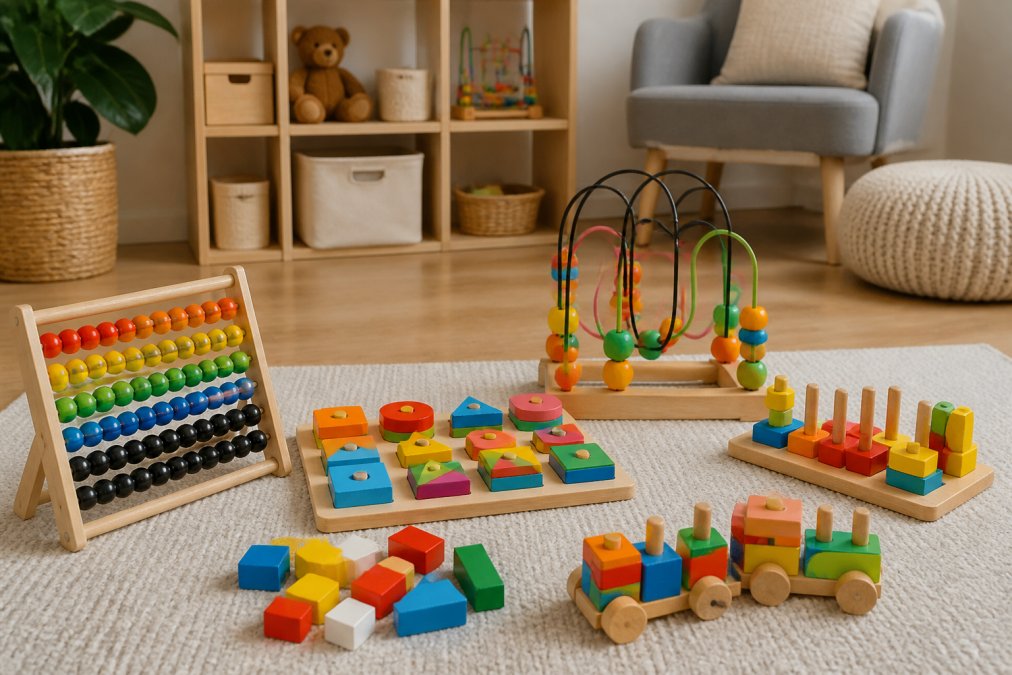
- Cylinder blocks and shape sorters: Build spatial reasoning and the concept of fit and proportion
- Sandpaper letters: Combine tactile and visual learning for early literacy
- Bead chains: Introduce counting and early multiplication through physical manipulation
- Practical life sets: Child-sized tools for pouring, sorting, and transferring develop concentration and fine motor control
- Nature trays: Collections of natural materials for sorting and classification build early scientific thinking
A common mistake is buying toys labelled "Montessori" without checking whether they actually follow the principles. Genuine markers are: natural materials where possible, a single learning concept per toy, and a self-correcting mechanism that doesn't require adult intervention.
Comparing Educational Toy Categories at a Glance
| Category | Best Age Range | Key Skills Built | Screen-Free | Replayability |
|---|---|---|---|---|
| Sensory and tactile toys | 0-18 months | Sensory processing, grip | Yes | High |
| Montessori tools | 1-6 years | Fine motor, concentration | Yes | Very high |
| Building and engineering sets | 3-12 years | Spatial awareness, creativity | Yes | Very high |
| Science experiment kits | 6-14 years | Scientific thinking, observation | Yes | Medium |
| Coding and robotics kits | 7-16 years | Logical reasoning, coding | Partial | High |
| Maths and strategy games | 5-15 years | Number sense, problem-solving | Yes | High |
| Role-play and imaginative sets | 2-8 years | Social-emotional growth, language | Yes | High |
Safety, Durability, and What to Watch Out For
Safety is the first filter when you buy educational toys for kids. A toy that poses a choking hazard, contains toxic paint, or breaks into sharp fragments is not a bargain at any price.
The Standards Organisation of Nigeria (SON) sets baseline requirements for toy safety in the Nigerian market. Reputable suppliers carry products that meet these standards, and many quality educational toys also conform to international testing benchmarks such as EN71 (European toy safety standard).
Durability matters equally. Many budget toys fall apart within weeks, making them poor value regardless of initial price. Before purchasing, ask:
- Are the materials non-toxic and free from sharp edges?
- Is the construction solid enough to withstand daily use?
- Does the supplier offer a replacement or return policy?
- Are small parts present that could be a choking hazard?
Counterfeit toys are a specific problem in many markets. Products that mimic well-known brand packaging but use inferior materials are common in informal retail channels. The safest approach is to buy from suppliers who can demonstrate product provenance and have a clear quality commitment.
MasterKids is built specifically around this concern. Every product is curated to meet safety standards, and the platform actively discourages counterfeit and low-quality items from reaching children.
Budget-Friendly and DIY Educational Toy Alternatives
High-quality educational toys do not require a large budget. Many effective early childhood learning tools can be assembled at home from everyday materials. According to early childhood education guidance from the UNESCO Institute for Lifelong Learning, the most important factor in educational play is adult engagement and intentionality, not the cost or complexity of the materials used.
Practical DIY alternatives that build skills:
- Sensory bins: A container filled with dried beans, sand, or rice with small objects hidden inside. Builds tactile sensitivity and fine motor skills for children aged one to four.
- Homemade sorting games: Bottle caps, buttons, or fabric scraps sorted by colour, size, or shape teach classification and early mathematical thinking.
- Cardboard construction: Cardboard boxes and masking tape provide open-ended building materials that rival commercial sets for creativity.
- Nature collections: Leaves, stones, and seeds collected on walks become sorting, counting, and classification materials.
- Homemade alphabet cards: Handwritten cards with letters and pictures build early literacy at zero cost.
DIY alternatives work best as supplements, not replacements. A well-designed commercial STEM kit or Montessori tool has been tested, refined, and structured in ways a homemade version typically cannot replicate. The best approach is to use DIY options to extend and reinforce learning from quality purchased toys.
For parents who want the best of both approaches, checking current pricing and availability at MasterKids is a practical starting point. The range is designed to offer genuine educational value at accessible price points, and the curation means you are not sorting through hundreds of irrelevant listings to find age-appropriate options.
Choosing the right educational toys is one of the most meaningful investments a parent can make in their child's early development. The challenge is navigating a market full of products that look educational but deliver little developmental value, alongside genuine safety concerns around counterfeit goods. MasterKids exists specifically to solve that problem: a curated, safety-verified range of educational toys, STEM kits, and learning resources for every stage from newborn to teenager. Shop the full range and find the right toy for your child's stage today.
Frequently Asked Questions
What are the best educational toys for a 4-year-old?
Four-year-olds benefit most from toys that build foundational skills through hands-on learning. Montessori-inspired shape sorters, alphabet puzzles, and simple building blocks support cognitive development, fine motor skills, and early literacy. Look for age-appropriate options labelled non-toxic and made from durable materials. At this stage, imaginative play is equally important, so toy kitchens, art sets, and collaborative board games all count as strong educational choices for preschool learning.
Are STEM toys worth the investment for primary school children?
For primary school children, STEM toys consistently support critical thinking, logical reasoning, and spatial awareness in ways standard classroom work often does not. Science kits, coding games, and engineering sets translate abstract curriculum concepts into hands-on problem-solving experiences. Children who engage with STEM toys regularly tend to develop stronger independent learning habits. The key is choosing a kit pitched at the right challenge level so the child stays engaged rather than frustrated.
How do I choose educational toys by age without wasting money?
Match the toy to the developmental milestones of the child's current age group, not the age printed on the box alone. A toy that is too simple offers no skill-building value; one that is too advanced causes frustration. Check that materials are non-toxic and durable enough to last beyond a few weeks of play. Buying educational toys for kids from a curated, quality-focused retailer reduces the risk of counterfeit or unsafe products reaching your child.
What are examples of educational toys that support cognitive growth?
Examples include building sets that develop spatial awareness and engineering thinking, science experiment kits that introduce hypothesis and observation, literacy tools like phonics card games that build reading skills, and maths board games that reinforce number sense. Montessori materials such as bead frames and sandpaper letters are also well-documented for early childhood cognitive development. The best options combine tactile interaction with open-ended problem-solving so children direct their own learning.
How do I know if educational toys sold online in Nigeria are safe?
Look for products that comply with the Standards Organisation of Nigeria (SON) requirements and carry clear age-grading and material disclosures. Avoid toys with small detachable parts for children under three, sharp edges, or strong chemical smells that may indicate non-compliant paint or plastics. Buying from a retailer that explicitly curates for safety and rejects counterfeit stock significantly reduces risk. Always check that the seller provides a clear returns or replacement process if a product arrives damaged or defective.
This article was written using GrandRanker