 blog
blog
Educational Toys for Primary School Students: 2026 Guide
Table of Contents
- Why Educational Toys Matter for Primary School Students
- STEM Kits for Primary School: Building Tomorrow's Problem Solvers
- How to Choose Safe and Genuine Educational Toys
- Educational Board Games for Kids: Learning Through Strategy and Fun
- Math Manipulation Toys for Primary School: Making Numbers Tangible
- Budget-Friendly and DIY Educational Toy Ideas
- Screen-Free Play vs Digital Integration: Finding the Right Balance
- Frequently Asked Questions
Last Updated: September 18, 2026
Why Educational Toys Matter for Primary School Students
Educational toys for primary school students are play items designed to build specific skills, such as problem-solving, literacy, numeracy and motor control, while a child is having fun. At MasterKids, we see this stage as the sweet spot for learning through play: children are curious and ready for a challenge, but learn best when the activity feels like a game.
STEM Kits for Primary School: Building Tomorrow's Problem Solvers
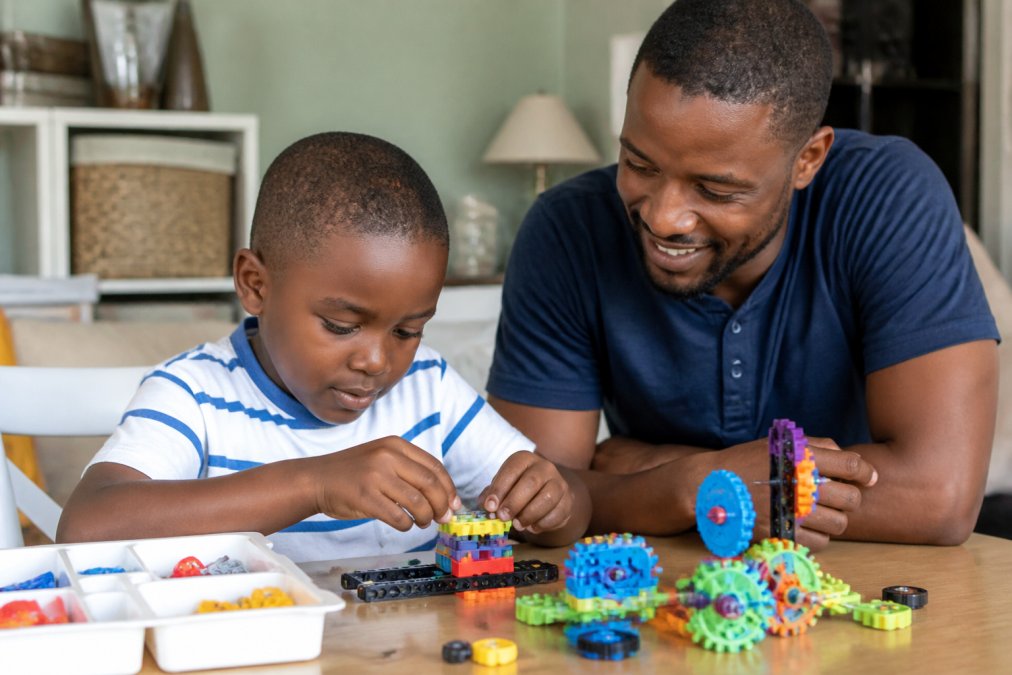
STEM kits for primary school are hands-on sets that introduce science, technology, engineering and maths through building and experimenting. Children learn these subjects best by doing: a child who has watched a gear turn another gear understands the idea far better than one who has only read about it.
The Main Types of STEM Kit
- Building and construction sets: interlocking bricks, gears, rods and connectors. These build spatial reasoning, planning and persistence. Best for ages 5 to 11.
- Simple mechanics kits: pulleys, levers, wheels and axles. Children build a working model, then change one part to see what happens, which builds cause-and-effect thinking.
- Basic circuits and electronics kits: snap-together or screw-terminal sets that light a bulb, spin a motor or sound a buzzer. Choose low-voltage, battery-powered sets with insulated connectors. Best for ages 8 and up.
- Magnetism and light kits: magnets, mirrors, prisms and lenses. Hard to break and endlessly repeatable, these make a strong first STEM purchase.
- Earth and life science kits: growing kits, weather stations, simple anatomy models. These suit children who prefer observing over building.
- Coding and logic kits: screen-free programmable robots and sequencing cards, plus a few app-linked kits. Prioritise screen-free options for younger children.
What to Look for in a STEM Kit
- Age-appropriate difficulty: the kit should stretch your child, not frustrate them. The first build should take roughly 20 to 40 minutes with some adult help; later builds should be doable alone.
- Clear instructions: picture guides work better than long paragraphs. Step-by-step diagrams with one action per panel beat a wall of text.
- Reusable parts: a kit your child can rebuild into something new lasts far longer. Open-ended sets outperform single-model kits that can only be built once.
- Safe materials: smooth edges, non-toxic finishes and sturdy pieces. Check that small parts are securely fixed and that any electrical components are low-voltage.
- Materials and lifespan: ABS plastic is durable and easy to clean; wooden sets feel warmer and are often more sustainable but can chip. What matters is that pieces survive repeated assembly.
A Unique Angle: STEM Kits for Neurodiverse Learners
Many primary school children are neurodiverse, and the right STEM kit can be transformative for them.
- For children with ADHD: choose kits with short, satisfying build cycles and a clear finished product. A model completed in one sitting gives the quick feedback loop that sustains attention. Avoid kits with 500+ pieces and no milestones.
- For children with autism: predictable, rule-based systems work well. Circuits, gears and sequencing kits have clear cause and effect, which reduces uncertainty, and a quiet, repetitive build can be calming rather than stressful.
- For children with dyspraxia or fine motor difficulty: look for larger connectors, magnetic pieces and chunkier tools. Magnetic building tiles are often easier to manipulate than small studs.
- For sensory-sensitive children: avoid kits with strong plastic smells, loud buzzers or flashing lights unless your child enjoys them. Wooden and matte-finish sets are often a better fit.
A Second Unique Angle: Sustainable STEM Choices
Parents increasingly want to avoid a house full of short-lived plastic. Options include:
- Wooden construction sets with non-toxic, water-based finishes
- Bamboo or recycled-cardboard building kits for lighter projects
- Refill and expansion packs rather than entirely new kits, so pieces get reused
- Buying one durable open-ended set instead of five single-use ones
How to Choose Safe and Genuine Educational Toys
Safety comes down to three checks: the materials, the construction and the source. Genuine toys from a trusted seller carry proper labelling, use non-toxic finishes and hold together under real play.
Checking Safety Standards and Authenticity
- Look for clear age guidance and warning labels on the packaging. Age labels reflect choking-hazard and developmental testing.
- Check for smooth edges, secure small parts and no strong chemical smell. A sharp plastic smell signals poor-quality materials.
- Buy from a seller who can tell you where the product came from and who stands behind it if something goes wrong.
- Avoid unusually cheap copies of well-known toys, as these often skip safety checks.
- Check that paints and finishes are non-toxic and lead-free, which matters most for toys children put in their mouths.
- For anything electrical, confirm it runs on low-voltage batteries rather than mains power, and that the battery compartment screws shut.
The Counterfeit Problem in the Local Market
Counterfeit and low-quality toys are a real problem in the market. A cheap copy may use unsafe paint or parts that snap into sharp pieces. Patterns worth knowing:
- Packaging that looks almost right but not quite: misspelled brand names, blurry logos, missing manufacturer addresses.
- No batch or model number: genuine products usually carry one so the maker can trace faults.
- Prices far below the normal range: if a well-known kit sells for a fraction of what every other seller charges, ask why.
- Loose or rattling parts inside sealed packaging: a sign of poor quality control.
A Unique Angle: Safety for Children with Additional Needs
Standard age labels assume a typically developing child. If your child has additional needs, apply a stricter test:
- Children who mouth objects: treat every small part as a choking risk, regardless of the age label, and choose larger-piece sets.
- Children with reduced grip strength: avoid heavy die-cast pieces that can drop on toes, and prefer lightweight wooden or foam components.
- Children with sensory sensitivities: check for strong smells, loud electronic sounds and harsh flashing lights before buying.
- Children prone to throwing: favour soft, rounded and lightweight toys over hard-edged or heavy ones.
A Unique Angle: Sustainable and Non-Toxic Materials
- Wood: look for solid wood with a smooth, sealed finish rather than painted surfaces that can flake.
- Bamboo and cork: lightweight, renewable and naturally splinter-resistant when finished well.
- Recycled cardboard and paper: excellent for puzzles and building kits, though less durable.
- Recycled plastics: a reasonable middle ground when you want durability without virgin plastic.
MasterKids exists to keep unsafe and counterfeit items out of Nigerian homes. Every product we stock is chosen for safety and quality, and our range is grouped by age and skill so you can match the toy to the child.
Educational Board Games for Kids: Learning Through Strategy and Fun
Educational board games for kids turn thinking into a shared activity. They teach turn-taking, planning and patience while the family laughs together.
Top Board Game Categories for Different Skills
| Game Type | Skill It Builds | Best For |
|---|---|---|
| Strategy games | Planning, critical thinking | Ages 7 and up |
| Word games | Literacy, vocabulary | Ages 6 and up |
| Number games | Numeracy, quick thinking | Ages 5 and up |
| Memory games | Focus, recall | Ages 4 and up |
Board games also give you something screens cannot: a reason to sit together. The social-emotional learning around a table, winning and losing gracefully, is as valuable as the academic skills.
Math Manipulation Toys for Primary School: Making Numbers Tangible
Math manipulation toys for primary school let children touch and move numbers instead of just writing them. Blocks, counters, fraction tiles and balance scales turn abstract ideas into something a child can see and hold.
Budget-Friendly and DIY Educational Toy Ideas
You do not need to spend a lot to give your child a rich learning experience. Some of the best educational toys are the ones you build together.
- Counting jars: fill a jar with bottle caps and let your child sort, count and group them
- Shape hunt: cut shapes from cardboard and ask your child to find matching objects at home
- Story dice: draw simple pictures on a cube and roll it to start a story
- Measurement games: use a ruler and everyday items to compare lengths and weights
Screen-Free Play vs Digital Integration: Finding the Right Balance
The healthiest approach is mostly screen-free play, with digital tools used on purpose rather than by default. Hands-on toys build fine motor skills, focus and patience in a way screens rarely do.
Frequently Asked Questions
What are the best educational toys for primary school students?
The best educational toys for primary school students match their developmental stage and interests. Building sets develop spatial reasoning, board games teach strategic thinking, maths manipulatives make abstract concepts concrete, and science kits encourage hands-on learning. Look for toys that are age-appropriate, safe, and genuinely engaging. At MasterKids, we curate options across all these categories so you can find the right fit for your child's needs.
How do educational toys help with primary school learning?
Educational toys support classroom learning by making abstract ideas tangible. Maths manipulatives help children visualise numbers, building sets strengthen fine motor skills and spatial reasoning, and board games develop critical thinking and collaborative problem solving. Research consistently shows that learning through play improves retention and engagement. The key is choosing toys that align with what your child is studying at school, so playtime reinforces lessons rather than competing with them.
Where can I buy high-quality educational toys in Nigeria?
MasterKids is a trusted online destination for educational toys in Nigeria. We offer a curated selection of STEM kits, board games, maths manipulatives, and more, all chosen for safety and developmental value. We also provide nationwide delivery, so you can shop from anywhere. Our goal is to get affordable, high-quality educational toys into the hands of every Nigerian child while discouraging counterfeit and unsafe products.
Are educational toys effective for improving problem-solving skills?
Yes, educational toys are highly effective for building problem-solving skills when they require children to think, plan, and adjust their approach. Puzzles, strategy board games, and building challenges all teach children to break problems into steps, test solutions, and learn from mistakes. The hands-on nature of these toys makes the learning stick. Choose toys that offer progressive difficulty so your child stays challenged as their skills grow.